You probably know how much your candy costs to produce. Do you know if you’re pricing enough to include every single thing involved in making a candy box?
It’s obvious you have to consider the candy itself. However, there are also candy boxes, cups, labels, ribbons, and your labor to package each item. Even smaller items could be overlooked individually because they’re easily missed when you examine them alone.
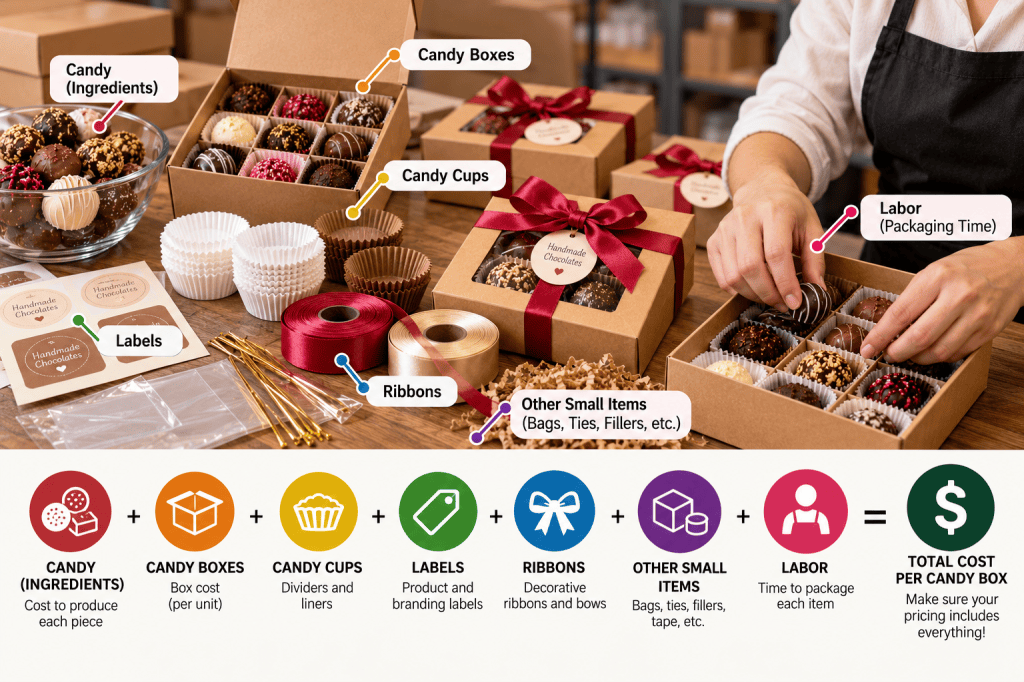
Begin with one complete product. Choose an item you commonly sell, e.g., six chocolates in a chocolate box. Produce the box as you would for a paying customer.
Record each separate item used. Record the candies, boxes, cup inserts, labels, seals, and additional wrapping. Record cards or ribbons added.
Obtain the cost of each item using your record of purchased supplies. For example, although packs of labels may appear inexpensive, some portion of that pack is utilized on each finished product. Calculate the actual cost per label by dividing the total cost of the pack of labels by the number of usable labels within that pack.
Calculate the cost for candy boxes and other products in the same manner. In addition to calculating the actual cost of purchased supplies, calculate the freight and/or other acquisition costs associated with purchasing supplies.
Time your work next. Begin counting your time when you collect an empty box and end counting when the completed set is ready for sale. Include folding, filling, checking, sealing, and applying a label.
If you want to get a better picture of how long you normally spend producing groups of boxes, try timing a few dozen instead of a single box. After completing production of a group of boxes, calculate the average time spent per box by dividing the total time by the number of boxes produced.
Don’t ignore items that do not meet your quality standards. Although broken candies or damaged candy boxes cannot be sold according to plan, they still represent lost dollars. Monitor wasted products during multiple batches to determine exactly how much is being thrown away.
After determining the actual cost of production, compare this cost with your selling price. Any remaining revenue must go toward paying rent, electricity bills, equipment maintenance and other expenses related to operating your business. All profit is not created equally.
Compare your various sized boxes now. A larger candy box may require more candy to fill but only slightly longer to prepare and package compared to preparing a smaller gift box. A small gift box requires nearly as many preparation procedures as a larger candy box.
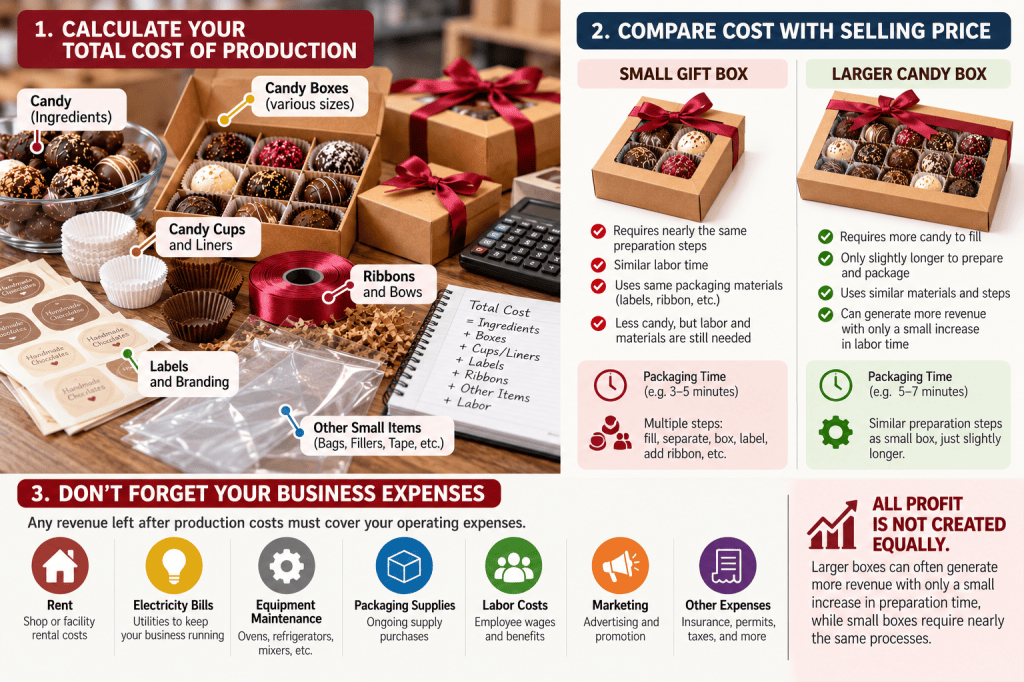
This doesn’t necessarily indicate that one type of candy box is incorrect; rather, both types need their own separate price comparisons.
Evaluate any additional options offered as well. When customers are allowed to customize their purchases by adding certain extras, i.e., ribbon, custom printed cards or specialty labels; evaluate whether these options should be free or cost extra. Inform customers of any costs prior to beginning production.
Update your spreadsheet whenever you experience changes in either your suppliers’ prices or your packaging methods. Your original pricing estimate may provide an unrealistic comparison of how profitable your current product is based on outdated information.

